

Give your robot the audio its AI needs
Intelligence is only as good as the sensory systems that feed it. We build the ears, the voice, and the audio infrastructure that bridges AI models cleanly with the physical world, in real time, at the edge.
Better audio input. Better robot intelligence.
Every Physical AI system has a brain: an AI model (or many) making sense of the world and deciding what to do next. What's consistently underbuilt is the body: the sensory infrastructure that feeds the brain clean, synchronized, usable data.
For audio, that means processing raw microphone input through noise cancellation, beamforming, echo cancellation, and format adaptation before it ever reaches your model. Synervoz builds that layer, so your AI gets what it needs to perform.
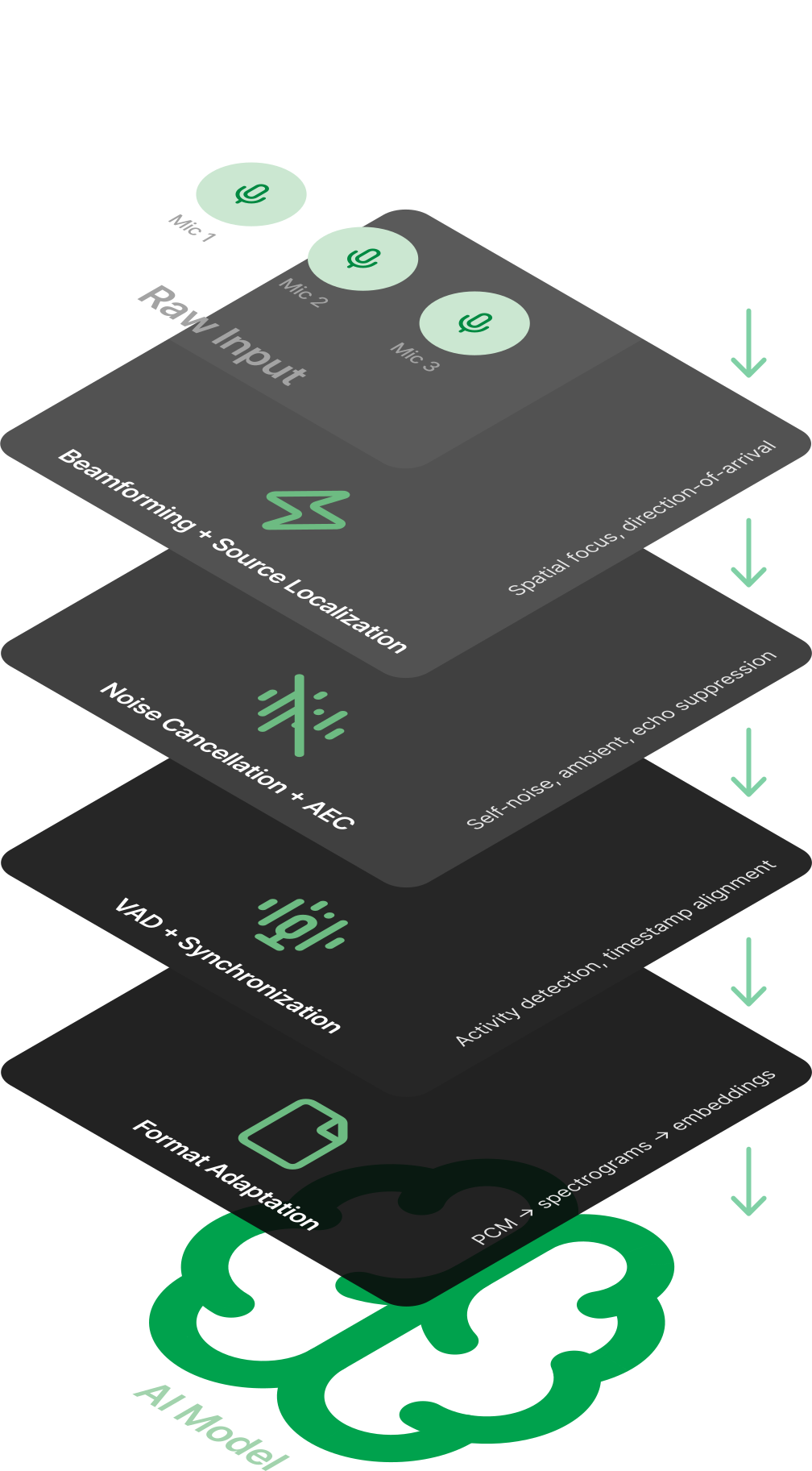
Built for Physical AI, all of it
Physical AI isn't just humanoid robots. It's any system where an AI model needs to perceive and act in the real world and needs audio infrastructure that can keep up.
Humanoid Robots
Natural conversation, command recognition, and speaker awareness in domestic, commercial, and eldercare settings. Motor self-noise suppression is table stakes here.
Industrial & Warehouse Robots
Voice-commanded picking and sorting on factory floors where ambient noise exceeds 90 dB. Audio must work where human communication already fails.
Drones & Aerial Systems
Acoustic sensing, voice interaction, and audio event detection in systems where rotor noise would overwhelm any standard microphone pipeline.
Service Robots
Multi-speaker recognition, hands-free interaction, and natural conversation in retail, hospitality, and healthcare environments with high acoustic complexity.
Why Physical AI audio is different
Standard audio middleware wasn't designed for this. The environments, the constraints, and the failure modes are fundamentally unlike anything in consumer electronics or enterprise software.
Your robot's own body is its worst enemy
Servo motors, actuators, and cooling fans generate 50–80 dB of mechanical noise that couples directly into the robot's chassis and microphone array. This isn't ambient noise you can beamform away. It comes from inside the system.
Environments that defeat standard DSP
Factory floors exceed 100 dB SPL. Metal-walled warehouses have reverb times over 1.5 seconds. Outdoor robots face wind noise, rain, and unpredictable propagation. None of this appears in standard training data or consumer audio specs.
Multi-model synchronization
VLA models fuse vision, language, and action. Audio arrives at 16–48 kHz; vision at 30 fps; motor control at 1000 Hz. Each downstream model expects different formats. Audio that arrives stale, misformatted, or out of phase breaks the entire inference pipeline.
Format and rate hell
Your ASR model wants 16 kHz mono PCM. Your VLA encoder wants mel spectrograms. Your speaker diarizer wants floating-point feature embeddings. And all of it needs to happen at wire speed, without adding latency to the critical path.
Edge power and compute constraints
A Jetson Orin NX has a 15W TDP shared across vision, audio, and language models. Wearables budget under 500mW. Drones trade every gram for flight time. The audio pipeline must do serious work inside very tight constraints.
The cocktail party problem, in motion
In a household with multiple people, a warehouse with workers, or a hospital ward, the robot must separate speakers, track who said what, recognize authorized voices, and handle interruptions — all while the acoustic environment changes as it moves.
The audio infrastructure stack you need
Switchboard SDK provides the full audio layer, from raw microphone capture to model-ready output, as a production-hardened, cross-platform foundation you integrate once and deploy everywhere.
Acoustic Front-End
Multi-channel beamforming, adaptive noise cancellation, acoustic echo cancellation (AEC), automatic gain control, and voice activity detection, all running together as a unified, low-latency pipeline.
Self-Noise Suppression
Reference-signal-based adaptive filtering that models and removes mechanically coupled motor and actuator noise: the noise your robot generates by moving at all. Not available in off-the-shelf audio SDKs.
Voice Pipeline Orchestration
End-to-end voice interaction management: wake word detection, ASR, LLM routing, TTS output, and barge-in handling — sequenced and timed to meet the latency budgets that conversational robots require.
Multi-Model Audio Sync
Sample-accurate timestamp alignment across audio, vision, and motor-control streams. Buffer management and stream routing that keeps heterogeneous AI models in sync, even when inference takes variable time.
Format & Rate Conversion
Real-time conversion between audio representations (PCM, floating-point, mel spectrograms, and model-specific embeddings) at wire speed, without adding to the critical path latency.
Cross-Platform Edge Deployment
C++ core with bindings for your stack. Runs on Jetson Orin, Qualcomm RB5, NXP, x86, and embedded Linux targets. Write once, deploy to your entire hardware fleet without platform-specific audio rewrites.
Stop rebuilding the audio stack. Start shipping.
The audio plumbing (noise cancellation, format conversion, sync, echo cancellation) is identical across companies. You're spending engineering time on infrastructure, not on what differentiates your product.
ROS 2 and similar frameworks provide message transport, not purpose-built audio processing. Teams wire together ad-hoc pipelines that break with hardware changes or model updates. Switchboard replaces that fragile glue with a production-hardened layer.
Switchboard integrates alongside your existing models. We sit between the microphones and the brain, cleaning, formatting, and synchronizing so your ASR, VLA, and LLM get the input quality they need to perform.
Critical-path audio always stays on-device. When connectivity is available, complex inference routes to the cloud. When it isn't, the system degrades gracefully. No hard dependency on a network that may not exist where your robots work.
Switchboard SDK has been hardened against the acoustic environments that Physical AI actually operates in (factory floors, outdoor settings, reverberant warehouses), not conference rooms and living rooms.
C++ core with bindings for Python, ROS 2, and more. Integrates with your existing sensor fusion pipeline without platform lock-in.
Ready to give your robot ears it can trust?
Whether you're integrating a voice pipeline for the first time or untangling a fragile custom audio stack, we can help you move faster — and build something that holds up in the field.